
NFL Line Movement Explained: Reading Odds Changes Before Kick-Off
 Available in US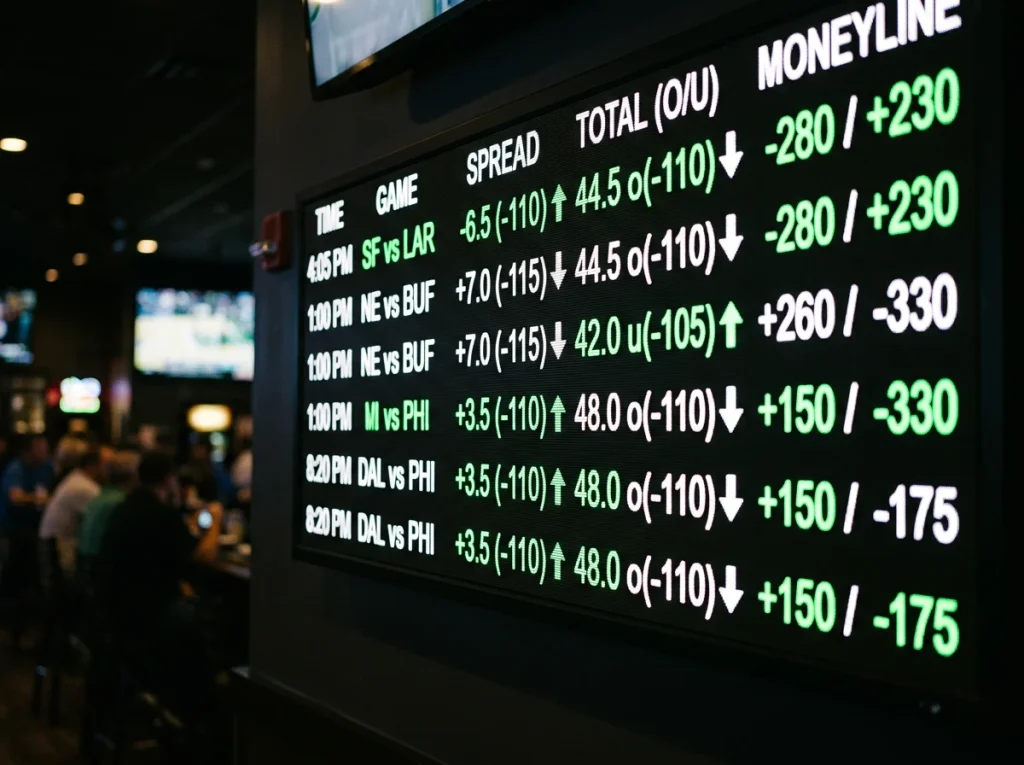
Thursday evening, Week 9, 2023. The opening spread on a Sunday afternoon game had the Bengals as 3-point favourites against the Bills. By Friday evening, the line had moved to Bengals -1.5. No injury news had broken, no weather shift, no obvious reason for a one-and-a-half-point swing. But sharp money was pouring in on Buffalo, and the books were moving the line to balance their exposure. I’d initially liked Cincinnati but hadn’t placed the bet yet. Seeing that move told me something important: people who bet for a living disagreed with my read. I passed on the game entirely. Buffalo won outright. That experience crystallised something for me — understanding line movement isn’t about having insider information; it’s about reading the market’s revealed preferences and adjusting your own analysis accordingly.
For UK punters accustomed to football odds that shift gently based on team news, NFL line movement can feel dramatic. Spreads can swing two or three points between the opening line and kick-off, and that movement contains information about how the market — including professional bettors, syndicates, and sharp bookmakers — assesses each game. Learning to read these movements is one of the most valuable skills an NFL bettor can develop.
How NFL Lines Are Set and Why They Move
I used to think bookmakers set NFL lines by predicting game outcomes. They don’t — at least, not primarily. Opening lines are generated using a combination of power ratings, algorithmic models, and historical data. The initial line represents the bookmaker’s best estimate of the number that will attract equal action on both sides. Once that line is posted and money starts flowing in, the line moves to reflect the weight of that money. If 70% of the handle lands on one side, the bookmaker shifts the line toward that side to encourage action on the other.
The important distinction is between money and tickets. Tickets represent the number of individual bets — the count of wagers. Money represents the total amount wagered. When ticket percentage and money percentage diverge, it usually means that recreational bettors are on one side (high ticket count, smaller individual wagers) while professional bettors are on the other (fewer tickets, larger wagers). A line that moves against the ticket majority — toward the side with fewer bets but more money — is being driven by sharp action.
Sharp bettors, often called “wiseguys” in American parlance, are professional or semi-professional gamblers whose action bookmakers respect because of their track record of winning. When a sharp bettor or syndicate places a large wager, bookmakers move the line not just to balance their book but because they trust the information embedded in that bet. Some bookmakers actively seek sharp action as a price discovery mechanism — they’d rather move their line to the “correct” number than be exposed to informed money on the wrong side.
Shane McLaughlin, trading director at BETDAQ, has noted that NFL lines can see significant price swings between opening and kick-off, particularly on games where injury reports or sharp money create one-sided pressure. For UK bettors, understanding these dynamics helps explain why the odds you saw on Wednesday morning might look very different by Sunday afternoon.
Reading Line Movement: Sharp Versus Public Money
My process for interpreting line movement starts with a simple question: does the movement make obvious sense? If a starting quarterback is ruled out on Friday and the line moves three points, that’s straightforward — the market is adjusting to new information. No edge there; the adjustment is rational and widely understood. But if the line moves two points between Tuesday and Saturday with no news to explain it, that’s a signal worth investigating.
Reverse line movement is the most commonly discussed sharp signal. It occurs when the line moves in the opposite direction from the public betting percentages. If 75% of tickets are on Team A, but the line moves toward Team A (making them less attractive), it means large, sharp money on Team B is outweighing the high volume of smaller public bets on Team A. Books are reacting to the weight of the stakes, not the count of the bets. Reverse line movement doesn’t guarantee a winner, but it identifies the side that professional money favours.
Steam moves are rapid, significant line movements that occur across multiple bookmakers simultaneously. When a sharp syndicate places coordinated bets across several sportsbooks, the line moves at all of them within minutes. These are harder for UK bettors to catch in real time because they often happen overnight UK time or during US business hours when the US market opens. However, tracking opening versus closing lines on historical data reveals which games experienced steam moves, and you can analyse whether following those signals would have been profitable.
The timing of movement matters. Early-week movement (Sunday night through Tuesday) is usually driven by sharp bettors who act on their models before the public has engaged. Late-week movement (Friday through Sunday) is more often driven by public money, injury news, and weather updates. The most informative movements are the early ones — they reflect genuine analytical conviction rather than reactive adjustments to widely known information.
Using Line Movement in Your UK Betting Strategy
I don’t blindly follow sharp money, and neither should you. What I do is use line movement as a check against my own analysis. If I’ve handicapped a game and like the home team at -3, but the line has moved from -3 to -1 on sharp action, I pause. Either the sharp money has information or analysis I’m missing, or my read is correct and the market has created a better number for me on the other side. Either way, the movement forces me to reassess rather than commit on autopilot.
Getting the best number is the single most important practical application of understanding line movement. In NFL spread betting, half a point matters enormously. A spread of -3 versus -2.5 on a favourite is the difference between a push and a loss when the favourite wins by exactly three. If you know that sharp money typically moves a line in a predictable direction — say, towards the underdog — then placing your bet before that movement gives you a better price. UK bookmakers don’t all move their lines at the same speed, which means shopping across platforms during periods of line movement can secure you a number that’s a half-point or full point better than what you’d get by betting at a single operator.
For UK bettors, the practical challenge is timing. NFL opening lines are typically posted on Sunday evening or Monday morning UK time. Sharp money begins to shape those lines through the week, with significant movement often occurring on Thursday and Friday as injury reports crystallise. If you do your handicapping on Wednesday and identify a side you like, placing the bet before the Thursday injury report can secure an opening-line price that subsequent movement will make unavailable by the weekend.
Conversely, if you prefer to let the market reveal information before committing, waiting until Saturday gives you the benefit of a full week’s worth of spread movement and news. The trade-off is clear: early bettors get the best numbers on the games they’re right about, but they also commit before all information is available. Late bettors have more information but worse numbers. The optimal strategy depends on your process — if your edge comes from modelling, bet early; if it comes from situational analysis and injury information, bet late.
Key Numbers and Why They Matter for Line Movement
NFL spreads cluster around certain numbers that reflect common scoring margins. Three is the most important key number because field goals are worth three points, making a three-point margin the single most common final scoring difference. Seven is the next most significant, reflecting a touchdown plus extra point. Games landing on exactly three or seven points happen frequently enough that half-point movements through these numbers carry outsized value.
When a line moves from -3 to -2.5, that half-point is worth far more than a move from -5.5 to -5, because the probability of the game landing on exactly three is much higher than it landing on exactly five. Sharp bettors obsess over key numbers, and you’ll often see resistance at -3 and -7 — bookmakers are reluctant to move through these numbers because the liability shift is disproportionate to the half-point change. When a line does cross through three, it signals that the pressure on the bookmaker is substantial enough to justify the increased exposure.
For UK bettors, buying or selling points through these key numbers — a feature offered by some operators where you can pay for a better spread — becomes mathematically worthwhile specifically around three and seven. Paying for a move from -3 to -2.5 costs a premium in reduced odds, but the probability gain is larger than the cost suggests. At other numbers, the cost-benefit is less favourable. Understanding key numbers transforms line movement from abstract market theory into practical price optimisation.
Tools and Resources for Tracking NFL Lines
When I started tracking line movement, I did it manually — checking opening lines, noting them in a spreadsheet, and comparing to closing lines. It was tedious but instructive. Now, several free and subscription resources automate this process. Odds comparison sites aggregate lines from multiple bookmakers, showing both current prices and historical movement. For UK bettors, these resources provide the same market transparency that American bettors have long taken for granted.
Odds comparison platforms show you which bookmaker currently offers the best price on each side of a game, and some display line movement graphs that visualise how the spread or total has changed since opening. Cross-referencing these movements with public betting percentages — available from various US-based sports analytics sites — gives you the raw data needed to identify sharp versus public-driven movement.
Build the habit of recording the opening line for every NFL game you’re interested in and comparing it to the closing line after kick-off. Over a season, this dataset reveals patterns: which types of movements are predictive, which directions of movement at which times of week correlate with covers, and how much value early versus late betting captures. The data is straightforward to collect and, over two or three seasons, becomes a powerful supplement to your handicapping.
Articles
Prepared by the GRIDLOCK editorial staff.
