
NFL Betting Strategy UK: Data-Driven Analytics
 Available in US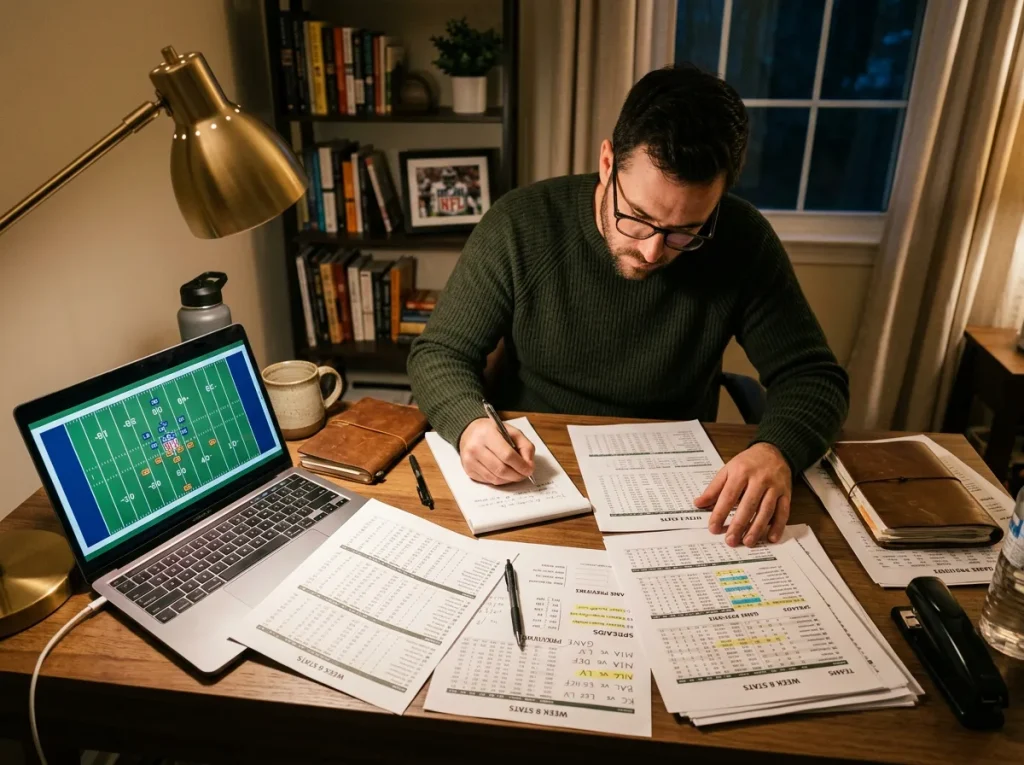
Three seasons ago, I tracked every NFL bet I placed across an entire year. All 312 wagers from September through the Super Bowl. The result wasn’t glamorous: a 53.8% win rate on spread bets and a 4.2% return on investment. What made it work wasn’t any single brilliant pick. It was the process behind the picks: a bankroll system I stuck to, a method for finding value, and the discipline to pass on games where I didn’t have an edge. Strategy, in NFL betting, is the boring stuff that makes the exciting stuff sustainable.
The UK is in the middle of an NFL betting boom. Entain’s data shows a 65% year-on-year increase in UK and Irish customers betting on the NFL during the 2024/25 season. A survey by Sigma in early 2026 found that 68% of UK bettors expected to increase their wagering activity over the coming year. That’s a lot of new money entering NFL markets, and new money without a strategy is the raw material that bookmakers rely on for profit.
This guide is the system I’d give myself if I were starting fresh. It’s built around principles rather than tips, because tips expire after kick-off while principles compound over seasons. I’ll cover bankroll management, implied probability, line shopping, situational factors, and the mistakes I see UK punters make most often.
To ensure long-term profitability, punters must combine their handicapping skills with strict NFL bankroll management to survive the inevitable downswings.
Capital Allocation Rules: NFL Bankroll Management
Every profitable NFL bettor I know started in the same place: deciding how much money they could afford to lose entirely, putting that amount into a separate account, and never topping it up. That number is your bankroll, and it’s the foundation of everything that follows. Without it, strategy is just opinion.
The standard unit size I use — and recommend — is 1-2% of your total bankroll per bet. If your bankroll is 1,000 pounds, a single wager should be between 10 and 20 pounds. This feels small when you’re confident in a pick, which is exactly the point. Confidence is not accuracy. I’ve been certain about games that lost, and lukewarm about games that won. The 1-2% rule protects you from your own certainty on the bets that go wrong.
Around 10% of the UK adult population actively places online sports bets, per Gambling Commission participation data. What separates the recreational majority from the profitable minority isn’t talent or inside knowledge — it’s money management. A bettor hitting 52% on NFL spreads with disciplined 1% unit sizing will outperform a bettor hitting 55% who sizes randomly and chases losses. The maths is unforgiving on this point.
Flat betting, wagering the same unit size on every play, is the simplest approach and the one I’d recommend for anyone reading this who hasn’t tracked at least 200 lifetime NFL bets. More advanced systems like the Kelly Criterion adjust stake size based on perceived edge, but they require accurate probability assessments that most bettors can’t reliably produce. Flat betting forgives bad estimates. Kelly amplifies them.
One practical point: keep your NFL bankroll separate from other sports. The NFL season runs from September to February, with a sharp drop in betting opportunities between the Super Bowl and the following autumn. If you’re pulling from the same pot for Premier League bets, horse racing, and NFL, your unit sizes become muddled and your performance tracking is meaningless. I maintain a dedicated NFL balance and review it at the end of each season. That review — wins, losses, unit profit/loss, win rate by bet type — is the data that drives next season’s approach.
Using Implied Probability to Find Value
If bankroll management is the foundation, implied probability is the compass. It tells you whether a bet is worth taking, regardless of how you feel about the matchup. I covered the conversion formulas in detail in my guide to NFL betting odds in the UK, so here I’ll focus purely on how to use those numbers as a strategic tool.
The process starts before you open a bookmaker’s app. Take a game — say, the Baltimore Ravens hosting the Miami Dolphins. You’ve reviewed the matchup: Baltimore’s rushing attack versus Miami’s defensive weaknesses up the middle, the weather forecast for an outdoor December game in Maryland, and both teams’ recent form. Based on your analysis, you estimate Baltimore wins 62% of the time.
Now you check the odds. The bookmaker has Baltimore at -155 on the moneyline, which implies a 60.8% win probability. Your estimate is 62%. The gap is just 1.2 percentage points — not enough to justify a bet, in my framework. I set a minimum threshold of 3% for moneyline bets and 2% for spreads before I’ll commit a unit. Those thresholds account for the bookmaker’s margin and the inherent uncertainty in my own assessments.
Suppose instead the moneyline is -130, implying 56.5%. Now the gap between your 62% and the bookmaker’s 56.5% is 5.5 percentage points. That’s actionable. You’re not betting because you “like” Baltimore — you’re betting because the price is wrong relative to your assessment. The distinction matters because it removes emotion from the equation and turns every bet into a mathematical decision.
Where many UK punters go wrong is skipping the first step — forming an independent probability estimate before seeing the odds. If you look at the odds first, your assessment unconsciously anchors to the bookmaker’s number. Psychological research calls this anchoring bias, and it’s pervasive in betting markets. The antidote is straightforward: do your research, write down your number, then open the app.
Line Shopping Across UK Bookmakers
Last November, I found a 2.5-point difference on the same NFL spread between two UK bookmakers. Same game, same market, different numbers. One had the favourite at -3.5, the other at -6. That kind of discrepancy is rare, but smaller differences — half a point on a spread, 10-15 ticks on a moneyline — appear every single week if you’re looking.
Line shopping means comparing odds across multiple bookmakers before placing a bet. It’s the simplest edge available to any UK punter, and it requires nothing except accounts at several operators and the patience to check them. The UK market has over 900 licensed operators according to IBISWorld, and while you don’t need accounts at all of them, having four or five active NFL betting accounts covers the major lines efficiently.
The impact compounds over time. If you consistently bet at -108 instead of -110 across 200 spread bets in a season, the difference in expected return is measurable. At a 100-pound unit size, that 2-tick improvement saves roughly 350-400 pounds over a full season compared to always taking the first price you see. It’s free money, delivered by the mundane act of checking a second screen.
An interesting demographic split: Gambling Commission data shows that 15% of UK men bet on sport compared to 4% of women. That gender gap suggests the UK’s NFL betting market is still maturing, and as participation broadens, more operators will compete on NFL pricing to attract new customers. Competition between bookmakers is what creates line-shopping opportunities, so the growth trend benefits anyone who comparison-shops.
One practical tip: line shopping is most effective early in the week, when bookmakers haven’t yet aligned their NFL numbers with the broader market consensus. By Saturday evening, most UK operators are within half a point of each other on spreads and within 5-10 ticks on moneylines. The biggest discrepancies appear on Monday and Tuesday, which is when I do the bulk of my early-week betting.
Weather, Injuries and Situational Factors
In December 2024, I watched a game in Buffalo where the wind chill dropped below -15 degrees Celsius and gusts topped 40 mph. The pre-game total was set at 41.5. It finished 13-10. Weather isn’t a tiebreaker in NFL betting — it’s a primary factor, and ignoring it is like analysing a horse race without checking the going.
Wind is the most impactful weather variable for NFL totals. Sustained winds above 15 mph suppress passing efficiency, which reduces scoring. Rain matters less than people think — modern NFL offences practice in wet conditions regularly — but heavy rain combined with wind creates a compounding effect that the totals market sometimes underestimates. Snow is mostly aesthetic. It looks dramatic on TV but has a smaller statistical effect on scoring than wind alone.
Temperature affects gameplay in outdoor stadiums but matters most for teams travelling from warm climates to cold-weather venues. A team based in Miami or Arizona playing a December road game in Green Bay or Chicago faces a physiological and psychological adjustment that shows up in performance data. I factor in temperature differentials, the gap between the visiting team’s home climate and the game-day conditions, rather than absolute temperature.
Injuries are the other situational factor that moves NFL lines more than anything else. The NFL’s official injury report, released on Wednesday, Thursday, and Friday of game week, classifies players as “full participant,” “limited,” or “did not participate.” The final designation (out, doubtful, questionable) comes on Friday evening US time, which is late Friday night or Saturday morning in the UK. Betting early in the week before injury reports are finalised carries risk, because a key player’s status can swing the line by multiple points.
I maintain a simple checklist that I run through before every bet: outdoor or indoor venue, wind speed forecast, precipitation, temperature, key injuries on both sides, and whether either team is on a short week (Thursday Night Football creates scheduling disadvantages for the teams involved). It takes ten minutes per game and catches situations where the market hasn’t fully priced in a factor that I believe is material.
Home-Field Advantage and Neutral-Venue Adjustments
Home-field advantage in the NFL is real, but it’s smaller than most UK bettors assume. The long-term historical figure sits around 2.5-3 points, meaning the average NFL team performs about that much better at home than on the road, all else being equal. Compare that to football, where home advantage in the Premier League can be worth a full goal in some analyses, and you can see why the NFL number deserves more nuance.
The advantage varies by team and by venue. Playing in Seattle’s notoriously loud stadium is a different experience from playing in a half-empty dome in Florida. Outdoor teams with extreme weather, like Green Bay in December or Denver’s altitude, have a larger home-field edge because visiting teams face environmental challenges on top of the standard travel factor. I adjust my estimates by 0.5-1 point for specific venues where I believe the conditions create an above-average home advantage.
Neutral-venue games deserve separate treatment. The NFL London games are the most prominent example for UK bettors, and I’ve developed a detailed framework for analysing those matchups. The key point here is that neither team has a home-field advantage in London, which eliminates the 2.5-3 point adjustment that would normally apply. Bookmakers generally account for this, but my experience is that they sometimes under-adjust, particularly when one team has a louder, more passionate UK fanbase.
Division rivalry games also warrant attention. Teams that play each other twice a year within their division know each other’s schemes intimately, which tends to compress the expected margin. The home team’s advantage in a divisional rematch is often smaller than in a non-conference game where the visiting team hasn’t faced the home environment in years.
Early Season vs Late Season: Adjusting Your Approach
September NFL is a different animal from January NFL, and your betting approach should reflect that. Early in the season, the market is working with limited current-year data — two or three games’ worth of evidence layered on top of projections from the offseason. That uncertainty creates wider spreads in quality assessments and, correspondingly, more mispriced lines.
I’ve found that Weeks 1-4 are the most profitable segment of the NFL calendar for spread betting. The reason is structural: bookmakers and the public alike are anchored to preseason narratives — last year’s playoff teams are overvalued, teams that made big roster changes in the offseason are either over-hyped or under-appreciated. The live performance data that would correct those biases hasn’t accumulated yet. By Week 8, the market has recalibrated, and the inefficiencies shrink.
Late in the season, a different set of opportunities emerges. Motivation becomes a factor. In December and January, some teams have been eliminated from playoff contention and are playing out meaningless games, while their opponents are fighting for seeding or a wild-card spot. The market tends to price these games on talent alone, underweighting the effort gap. I track playoff-clinching scenarios from Week 14 onward and adjust my assessments for teams with nothing to play for.
The Sigma survey finding that 68% of UK bettors intended to increase their activity in 2026 points to a growing market, but it also signals a potential seasonal trap. Many new bettors enter during the playoffs, when the games are highest-profile and the betting volume peaks. Playoff NFL lines are the sharpest of the season — the market has a full 18 weeks of regular-season data to work with, and the remaining teams are all competent. Finding value in the playoffs requires a higher level of analysis than the regular season demands. If you’re new to NFL betting, I’d suggest treating the playoffs as a time to bet smaller and learn, not to swing for the fences.
Discover more data-driven insights and expert predictions at the leading UK NFL betting guide.
Seven Mistakes UK NFL Bettors Make
I’ve made every one of these mistakes at some point, so this list is drawn from painful personal experience rather than theory.
The first mistake is treating the NFL like the Premier League. UK punters who grew up betting on football naturally gravitate toward match result markets, picking the outright winner. In American football, the point spread is the primary market for a reason: it levels the playing field between mismatched teams and offers a more precise bet. Backing the Kansas City Chiefs to beat a weak opponent at 1/8 is dead money. Backing them to cover a 10-point spread requires actual analysis. If you’re not engaging with spreads and totals, you’re leaving the most interesting — and most exploitable — markets untouched.
The second mistake is ignoring bankroll management entirely. The UK’s 900+ licensed betting operators make it absurdly easy to open accounts, deposit funds, and start wagering. That accessibility is a double-edged sword. Without a unit system and a clear staking plan, most bettors have no idea how much of their bankroll they’re risking on any given Sunday. I covered this earlier, but it bears repeating: flat staking at 1-3% per bet is the single most impactful change a losing bettor can make.
Third: anchoring to preseason narratives. Every September, the public has a consensus about which teams are good and which are bad, shaped by offseason hype, draft picks, and media coverage. These narratives are slow to update. A team that was projected to contend but starts 1-3 will still attract public money at inflated lines because the bettor “knows” they’re good. The market corrects this by mid-season, but the first month offers value to anyone willing to bet against stale reputations.
Fourth is chasing losses. The NFL schedule hands you 14-16 games every Sunday, which feels like plenty of opportunities to “get it back” after a morning loss. It never works. Chasing leads to larger bet sizes, worse analysis, and emotional decision-making. My rule: if I lose my first two bets of the day, I stop. The games will still be there next week.
Fifth: betting parlays as a primary strategy. Parlays, called accumulators in UK betting parlance, are popular because they offer large potential payouts from small stakes. The Gambling Commission’s data showing that roughly 10% of UK adults bet regularly suggests a large casual market, and casual bettors love accumulators. The problem is mathematical: each leg multiplies the bookmaker’s edge. A four-leg parlay at standard -110 juice carries an effective margin of roughly 30%. Single bets and targeted two-leg combinations are where long-term profit lives.
Sixth: neglecting the time zone factor. NFL games kick off at 6pm, 9pm, and sometimes 1:20am UK time. Late-window games and Sunday Night Football coincide with the hours when concentration fades and alcohol consumption rises. I’ve placed some of my worst bets after midnight, half-watching a game while convinced I’d spotted a live-betting angle. If your edge depends on sharp analysis, recognise that your analytical ability drops after a certain hour and set hard limits accordingly.
The seventh mistake is failing to specialise. The NFL has 32 teams playing 18 regular-season games each, plus playoffs. Trying to bet across the entire slate every week is a recipe for surface-level analysis. The bettors I know who consistently profit focus on 8-10 teams, learn those rosters and coaching tendencies inside out, and pass on everything else. Depth of knowledge beats breadth in a sport this complex.
Frequently Asked Questions
Articles
Written by the editors at GRIDLOCK.
