
NFL Betting Odds UK: Compare Sportsbook Lines
 Available in US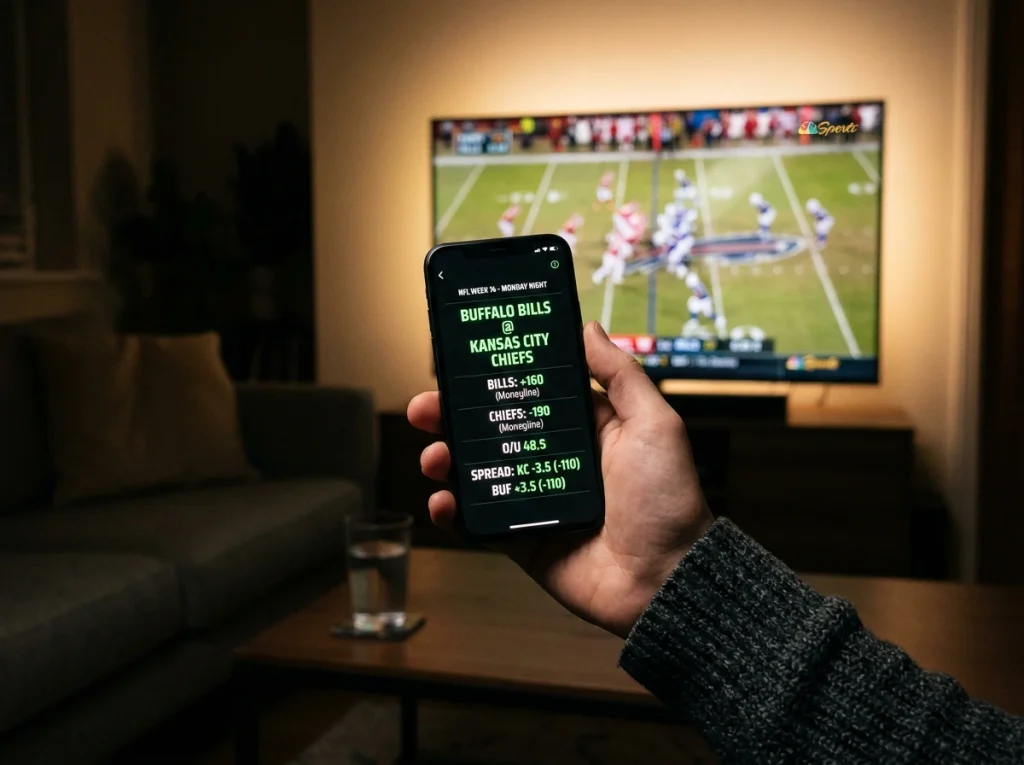
I still remember the first time I pulled up NFL odds on a UK bookmaker’s site. It was 2017, a Thursday night game, and the numbers made no sense whatsoever. Minus 150? Plus 130? I’d been betting on Premier League matches for years and could read fractional odds in my sleep, yet here I was staring at a format that felt like it belonged in a maths textbook. Nine years later, I’ve converted thousands of those lines, and I can tell you the confusion was entirely unnecessary — the system is logical once someone explains it without jargon.
That explanation is long overdue for the UK market. Around 10% of the UK adult population actively bets on sport online, per Gambling Commission participation data, and NFL is the fastest-growing segment within that base. Entain — the group behind Ladbrokes and Coral — reported a 65% year-on-year increase in the number of British and Irish customers placing NFL bets during the 2024/25 season. Yet nearly every guide available to UK punters either skips the odds-format problem entirely or buries it in a paragraph between bookmaker ads.
This article does the opposite. I’m going to walk through every odds format you’ll encounter, give you the conversion formulas with real examples, and show you how to turn those numbers into something genuinely useful: implied probability and, ultimately, value. If you’ve ever copied an American line into a search engine just to figure out what it pays, this is for you.
If you are accustomed to traditional UK pricing, using an American odds to fractional converter is essential for quickly identifying market value.
Odds Formats Explained: American NFL Lines
Walk into a pub in Manchester and ask what odds mean, and the answer will involve fractions — 5/1, 7/2, evens. Cross the Atlantic and the same conversation happens in plus and minus signs. Neither system is better; they’re just different ways of expressing the same underlying probability. The third option, decimal odds, sits somewhere between the two and has become the default on European betting exchanges.
The NFL uses American odds because that’s what the Las Vegas sportsbooks adopted decades ago. When UK bookmakers started offering NFL markets, many of them simply imported the American format alongside the games. Some operators let you toggle between formats in your account settings. Others display whichever format they think you want based on your location. The result is chaos. You might see -110 on one screen, 10/11 on another, and 1.91 on a third, all for the same bet.
Here’s the fundamental difference. Fractional odds tell you your profit relative to your stake: 5/1 means you win five pounds for every one pound wagered. American odds use a baseline of 100 units. Decimal odds show the total return including your stake. All three are just different containers for the same information, and once you understand the relationship, converting between them is arithmetic, not alchemy.
Why does this matter practically? Because when you’re comparing NFL lines across multiple bookmakers — and you should be, since the UK market has over 900 licensed operators according to IBISWorld data — you need a common language. I use decimal odds as my conversion standard because they make the maths cleanest, but we’ll cover all three so you can work in whichever format your preferred platform displays.
One more thing worth noting: American odds are the native language of NFL analysis. When you read injury reports, line movement commentary, or sharp-money alerts from US analysts, they’ll quote numbers in American format. Learning to read them fluently, rather than converting every single number, saves you time and keeps you closer to the source material.
American Odds Decoded: Plus, Minus and What They Mean
A minus sign in front of a number tells you how much you need to stake to win 100 units. A plus sign tells you how much you win from a 100-unit stake. That’s the entire system. Everything else is just working the formula.
Let’s say the Kansas City Chiefs are listed at -150 on the moneyline. That means you’d need to risk 150 pounds to profit 100 pounds. The Chiefs are the favourite in this scenario — the minus sign always denotes the favourite. Now suppose the Cincinnati Bengals are on the other side at +130. A 100-pound stake on the Bengals would return 130 pounds in profit if they win. The plus sign marks the underdog.
Where it gets interesting is around the -110 line. This is the most common number you’ll see in NFL spread and totals betting, and it exists because of the bookmaker’s margin. Both sides of a standard spread bet are typically priced at -110, which means both teams require a 110-pound stake to win 100 pounds. That built-in 10% over the break-even point on each side is how the operator makes money. In fractional terms, -110 converts to 10/11. If you’ve ever bet at 10/11 on a football handicap, you already know this price intuitively.
Numbers further from -110 indicate a stronger opinion from the market. A -300 favourite is heavily fancied — you’d need to risk 300 to win 100. A +250 underdog is seen as a long shot, paying 250 for every 100 staked. The relationship between these two sides of the market isn’t always symmetrical, and that asymmetry is where sharp bettors start looking for edges.
One detail that trips people up: American odds don’t have a zero. The scale jumps from -100 (even money from the favourite’s side) directly to +100 (even money from the underdog’s side). In practice, you’ll rarely see -100 or +100 listed because bookmakers build their margin into both prices, but it helps to understand that the gap in the number line is intentional, not a glitch.
I think of minus odds as “how much do I invest to get 100 back” and plus odds as “what do I earn on a 100 bet.” Once that clicks, reading a full NFL odds board takes seconds rather than minutes. And if you’re the type who prefers fractions, keep reading — the conversion is next.
Converting Between American, Fractional and Decimal Odds
I keep a cheat sheet pinned to my desktop. Not because I can’t do the maths, but because at 1:15 a.m. on a Sunday — halfway through the late NFL slate — speed matters more than elegance. Here are the formulas I use every week.
American to Fractional
For positive American odds, divide by 100 and express the result as a fraction. +150 becomes 150/100, which simplifies to 3/2. +200 is 200/100, or 2/1. For negative American odds, put 100 over the absolute value. -150 becomes 100/150, which simplifies to 2/3. -110 is 100/110, or 10/11.
If you bet Premier League markets at 2/3, you’re already comfortable with -150 NFL odds — same price, different label.
American to Decimal
Positive odds: divide by 100 and add 1. So +150 becomes 1.50 + 1 = 2.50. Negative odds: divide 100 by the absolute value and add 1. So -150 becomes 100/150 + 1 = 1.667. Decimal odds always include your stake in the return, which is why even money is 2.00 in decimal (you get your 1 unit back plus 1 unit of profit).
Fractional to American
If the fraction is greater than or equal to 1/1, multiply by 100 to get positive American odds. So 3/1 becomes +300. If the fraction is less than 1/1, divide 100 by the fraction’s decimal value and put a minus sign in front. So 1/2 in decimal is 0.50, and 100 / 0.50 = 200, giving you -200.
Worked Example: Full Conversion
Let’s take a real-world scenario. The Philadelphia Eagles are -180 on the moneyline against the Dallas Cowboys at +155. Converting the Eagles: fractional = 100/180 = 5/9; decimal = (100/180) + 1 = 1.556. Converting the Cowboys: fractional = 155/100 = 31/20; decimal = (155/100) + 1 = 2.55. A 50-pound bet on the Cowboys at +155 (decimal 2.55) returns 127.50 pounds total — 50 stake plus 77.50 profit.
The mental shortcut I use most often: for negative odds, I ask “how many pounds do I need per pound of profit?” At -180, that’s 1.80 per pound of profit. For positive odds, I flip it: “how many pounds do I earn per pound risked?” At +155, that’s 1.55 per pound. This phrasing maps directly to what your account balance actually does when you win.
Once you’ve practised a dozen conversions, the process becomes automatic. But there’s a more valuable skill built on top of these formulas — turning any odds format into a probability percentage.
Implied Probability: Turning Odds into Percentages
Every set of odds hides a percentage. That percentage represents what the bookmaker’s price implies about the likelihood of an outcome. Finding it is the single most useful skill I’ve developed in nine years of NFL betting, because it turns an abstract number into a question you can actually answer: “Do I believe this team wins more often than X percent of the time?”
The formula for negative American odds: implied probability = absolute value of odds / (absolute value of odds + 100), then multiply by 100 to get a percentage. For -150: 150 / (150 + 100) = 150 / 250 = 0.60, or 60%. The bookmaker’s price implies the favourite wins 60% of the time.
For positive American odds: implied probability = 100 / (odds + 100), multiplied by 100. For +130: 100 / (130 + 100) = 100 / 230 = 0.4348, or about 43.5%.
Now, add those two implied probabilities together: 60% + 43.5% = 103.5%. The total exceeds 100%, and that surplus — 3.5 percentage points in this case — is the bookmaker’s overround, also called the vig or juice. It’s their built-in profit margin. No market in the world sums to exactly 100%, because if it did, the bookmaker would make nothing.
For decimal odds, the conversion is even simpler: implied probability = 1 / decimal odds. So 2.50 becomes 1 / 2.50 = 0.40, or 40%. For fractional odds, it’s denominator / (numerator + denominator). At 3/1, that’s 1 / (3 + 1) = 25%.
I’ve built this check into my pre-bet routine. Before placing any NFL wager, I convert the odds to implied probability and compare that number against my own assessment. If the bookmaker implies the Buffalo Bills have a 55% chance of covering the spread, and my analysis of the matchup puts it at 62%, there’s a gap worth exploiting. If the numbers roughly agree, I pass. The discipline is in doing this every time, not just when a game feels interesting.
One caveat: the implied probability you calculate from raw odds includes the overround, so it slightly overstates the bookmaker’s true view. To get a “fair” probability, you can remove the overround by dividing each side’s implied probability by the total and scaling back to 100%. But for quick assessments, the raw number is close enough to be actionable.
Identifying Value in NFL Odds
Greg Ferris, Entain’s Managing Director for Sports, said something in 2024 that stuck with me: the UK’s NFL fanbase is “committed and knowledgeable.” He was talking about why betting volumes keep rising, but the comment points to something else — a market where informed punters can find genuine value because the odds-setting infrastructure is still catching up to demand.
Value exists when the implied probability from the odds is lower than the actual probability of the outcome. Think of it like shopping. If a jacket is priced at 80 pounds and you know it’s worth 120, you buy. In betting, if the odds imply a 45% chance and you assess the true probability at 55%, that’s a value bet regardless of whether it wins or loses on any given Sunday.
The UK online sports betting market generated £8.9 billion in revenue in 2024 and is projected to reach £17 billion by 2030, per Grand View Research. That growth means more liquidity, more operators competing on NFL lines, and more opportunities where individual bookmakers misprice games relative to the broader market. The catch is that you have to look.
My approach to identifying value starts with building an independent view before seeing the odds. I’ll review the matchup — offensive and defensive rankings, injury reports, weather forecasts for outdoor stadiums, recent performance trends — and estimate a win probability. Only then do I open the bookmaker’s app. If the gap between my number and their number exceeds a threshold I’ve set (typically 5 percentage points for moneylines, 3 for spreads), I consider it actionable.
This doesn’t mean I win every bet. Value betting is a long-term strategy. Over hundreds of wagers, consistently finding 3-5% edges compounds into meaningful returns. Over five bets, anything can happen. The distinction matters because too many UK punters I’ve spoken to abandon a sound process after a bad weekend, which is exactly the wrong response.
For a deeper look at how to build these assessments into a repeatable system, I’ve written a full breakdown of NFL betting strategy tailored to the UK market.
Line Movement: Why NFL Odds Shift Before Kick-Off
Last October, I watched the line on a London game move from -3 to -1.5 in under two hours. No injury announcement, no weather change — just money. Someone with deep pockets had a different opinion to the opening number, and the bookmaker adjusted. Understanding why lines move is as important as knowing how to read them.
NFL odds are first set by a small team of oddsmakers at the primary market-making sportsbooks. These opening lines are released early in the week — sometimes on Sunday evening for the following week’s games. From the moment they go live, the market reacts. Professional bettors, often called “sharps,” place large wagers if they believe the opening number is off. Recreational bettors tend to come in later, often on game day. The bookmaker adjusts the line in response to the weight of money on each side, trying to balance their risk.
For UK punters, the practical consequence is timing. If you bet on Monday morning for a Sunday game, you’re seeing a relatively raw line that may still reflect the sharp-money consensus. If you wait until Saturday evening, the line has been shaped by five days of action and information — injury reports, practice participation data, weather updates. Neither timing is inherently better, but they produce different opportunities.
Reverse line movement is a signal worth watching. This occurs when the majority of public bets are on one side, yet the line moves in the opposite direction. It suggests the bookmaker has received significant sharp action against the public position and considers that money more informative than the volume on the other side. I track this using free consensus data from US sportsbook aggregators, and it’s flagged some of my best NFL bets over the years.
Weather is an underrated line mover for NFL games. An outdoor December game in Green Bay with 30-mph winds will see the total drop significantly from the opening number. If you’ve already bet the under at the higher opening total, the line movement confirms your thesis and locks in a more favourable position. If you haven’t bet yet, you’ll get worse odds because the market has already priced in the information.
The global sports betting market reached approximately £70 billion in revenue in 2026, per Statista Market Insights. With that much capital flowing through odds markets worldwide, the days of wildly mispriced NFL lines are rare. But line movement still creates windows — if you know where to look and when to act.
Access our full suite of betting tools and weekly matchup breakdowns directly on the GRIDLOCK homepage.
How UK Bookmakers Display NFL Odds
Not all UK platforms treat NFL odds the same way, and the inconsistency can cost you money if you’re not paying attention. Some operators default to fractional display for all sports, converting American lines behind the scenes. Others show American odds for NFL markets specifically, reasoning that their NFL customers prefer the native format. A smaller group defaults to decimal across the board.
The issue isn’t which format appears on screen — it’s what happens to precision during conversion. A line of -107 converts to approximately 100/107 in fractional, but most UK bookmakers will round that to 10/11 (which is actually -110). That rounding costs you a few pence per pound wagered, and over a season of hundreds of bets, the pennies compound. William Hill captures nearly 38% of pay-per-click traffic in the UK sports betting segment, per Adthena data from early 2026, but market share doesn’t guarantee the best NFL odds display. Smaller operators sometimes offer more granular pricing.
My recommendation: switch your account settings to decimal odds. Decimal is the most precise common format because it avoids the rounding inherent in fractional display and translates directly into total return. Every major UK bookmaker allows you to change this in your profile or account preferences. It takes ten seconds and immediately clarifies every NFL line you see.
Another quirk of the UK market: some platforms list NFL spreads using a format that looks like Asian handicap notation from football betting. You might see “Philadelphia Eagles -3.5” with odds displayed as 10/11, which is essentially the same as -3.5 (-110) in American notation. If you’ve bet on Premier League or Champions League handicaps, this should feel familiar. The mechanics are identical — it’s just the sport that changed.
Finally, watch for early-week odds availability. US sportsbooks typically release full NFL lines by Sunday evening Eastern Time, which is the early hours of Monday morning in the UK. Some UK operators are faster than others at putting these markets live. If your strategy involves betting early lines, it’s worth checking which of your accounts consistently posts NFL odds first. That small timing advantage can mean the difference between catching a value line and arriving after the market has corrected.
Frequently Asked Questions
Articles
Published by the GRIDLOCK team.
