
NFL Cash Out Betting UK: Fast Settlements
 Available in US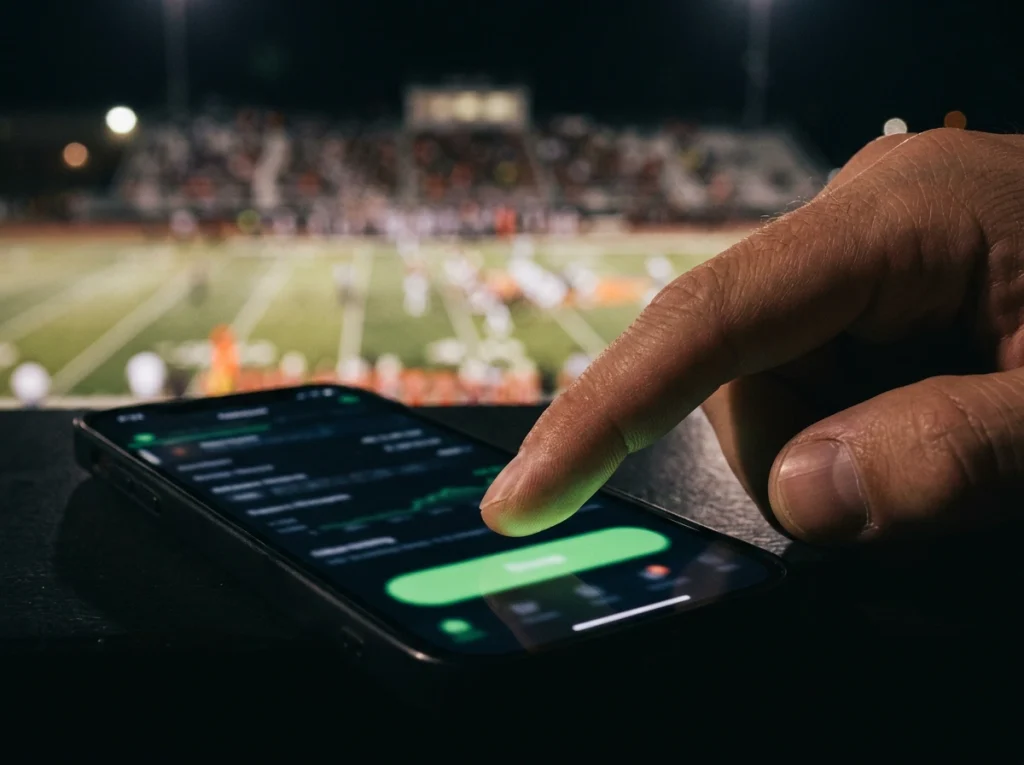
The first time I used cash out on an NFL bet, I panicked. I had a three-leg accumulator: two legs had landed, and the third was Kansas City to cover a four-point spread. Midway through the fourth quarter, KC led by six, and the cash-out offer sat at roughly 70% of the potential full payout. I stared at the screen, watching the offer tick up and down with every play. A Chiefs field goal made it a nine-point lead, the cash-out offer jumped. An opponent’s quick touchdown brought it back down. I cashed out during a timeout, collected my money, and then watched the Chiefs cover comfortably. I left profit on the table — but I also avoided the risk of a backdoor cover that would have wiped the bet entirely.
That tension between guaranteed money now and potential money later is the core of cash-out strategy. The volume of online bets placed on UK platforms each month is vast and growing, and a significant portion of those bets involve some form of cash-out interaction. Understanding when cashing out adds value and when it costs you money is one of the most practical skills an NFL bettor can develop.
Settlement Mechanics: Using Sportsbook Cash Outs
Cash out lets you settle a bet before the event finishes, at a price determined by the bookmaker based on current odds and the state of the market. The offer reflects the live probability of your bet winning, adjusted by the bookmaker’s margin. If your bet is currently more likely to win than when you placed it, the cash-out offer will be higher than your original stake. If it’s less likely, the offer will be lower.
The mechanics are straightforward. You open your active bets, find the NFL wager in question, and the app displays a cash-out value. Tap to accept, and the bet is settled at that value. Your original bet is voided, and the cash-out amount is credited to your account. The underlying game continues, but your financial involvement ends at the moment you accept.
The UK serves 12.7 million active online gambling accounts per month on average, according to Gambling Commission Q3 2025/26 data. Cash out is now standard across virtually all of those platforms, but the quality of implementation — speed, reliability, frequency of offer updates — varies meaningfully between operators. During volatile NFL in-play moments, some platforms update cash-out offers every few seconds while others lag by ten to fifteen seconds, which in a fast-moving game can represent an entirely different game state.
Not all bet types support cash out. Pre-match singles and accumulators almost always do. Same-game parlays sometimes do, depending on the operator. Certain exotic markets — first touchdown scorer, novelty props — may not support cash out at all. If cash-out flexibility is important to your NFL betting approach, verify market-specific availability before placing the bet.
Full Cash Out vs Partial Cash Out
Full cash out settles the entire bet at the current offer. You walk away completely. Partial cash out lets you settle a portion of your bet while leaving the rest active. This is the more strategically interesting option.
Suppose you’ve placed a twenty-pound accumulator that’s currently showing a cash-out offer of eighty pounds, with a potential payout of one hundred and forty if all legs win. With partial cash out, you might settle half the bet for forty pounds — guaranteeing that money regardless of what happens — while leaving a ten-pound equivalent still riding for a potential seventy-pound return. If the final leg wins, you collect one hundred and ten total (forty cashed out plus seventy from the remaining portion). If it loses, you still have the forty pounds.
Partial cash out is particularly valuable during NFL playoff games and Super Bowl betting, where emotional pressure to cash out early is highest. Rather than making a binary all-or-nothing decision in the heat of a fourth-quarter drive, you can de-risk progressively — cashing out a slice after each successful leg or at each key game moment.
The practical limitation is minimum partial cash-out amounts. Most operators require you to cash out at least a certain percentage of the total offer, and the remaining active portion must still meet minimum stake requirements. These thresholds are small enough that they rarely interfere with NFL bets, but they’re worth checking if you’re working with small stakes.
Cashing Out During a Live NFL Game
NFL’s structure makes it unusually well-suited to in-play cash-out decisions. The stop-start nature of the game — huddles, timeouts, two-minute warnings, commercial breaks — gives you natural decision points where the action pauses and the cash-out offer stabilises briefly. Unlike football, where play is continuous and offers shift constantly, NFL gives you windows to think.
The key moments when cash-out offers change most dramatically: scoring plays (touchdowns, field goals), turnovers (interceptions, fumbles), and momentum-shifting penalties. After a touchdown, if you’re on the scoring team’s side, the cash-out offer spikes. If you’re on the conceding team’s side, it drops. The speed of that adjustment depends on the operator’s pricing model.
A practical approach is to identify your cash-out decision points before the game starts. If your bet is on a team to cover a 3.5-point spread, decide in advance: at what lead will I consider cashing out? If they’re up by 10 at halftime, is that enough? What if they’re up by 10 but the opponent receives the second-half kick-off? Having a framework prevents emotional decision-making during live action.
For a broader look at how NFL live betting works — including momentum reads and in-play market structure — the live betting guide covers the full tactical landscape.
One underrated factor: NFL game script. A team leading by 14 in the fourth quarter will often switch to a conservative running game, which burns clock and reduces the probability of further scoring. If your bet needs the game total to stay under a certain number, that shift to run-heavy play might actually improve your position even without further scoring. The cash-out offer should reflect this, but it doesn’t always adjust instantly. In those moments, the cash-out offer may undervalue your position, and holding is the better choice.
When Cash Out Makes Strategic Sense
Cash out is not inherently good or bad — it’s a tool, and like any tool, its value depends on how you use it. The bookmaker’s cash-out offer always includes a margin, meaning the mathematical expected value of holding the bet is typically higher than cashing out. But expected value isn’t the only consideration.
Cash out makes sense when your assessment of the game has changed since you placed the bet. If you backed a team pre-match based on their starting quarterback, and that quarterback leaves injured in the first quarter, the game fundamentally changed. The cash-out offer might still be above your stake if the team was leading when the injury occurred. Taking it is rational because the bet you placed no longer reflects the game in front of you.
It also makes sense for bankroll protection. David Highhill, VP of Sports Betting at the NFL, has noted the league’s concern about market integrity and price distortion in unregulated environments. In regulated UK markets, cash out is a transparency tool — it gives you a real-time price on your position. If that price represents meaningful profit relative to your bankroll, taking guaranteed money can be the disciplined choice, even if the expected value of holding is marginally higher.
Cash out rarely makes sense when driven purely by anxiety. If nothing about the game has changed and your original reasoning remains intact, cashing out because the fourth quarter feels tense is paying a margin to the bookmaker in exchange for emotional relief. Over hundreds of bets, that margin adds up. The discipline to hold a well-reasoned bet through volatility is one of the hardest skills in sports betting — and one of the most profitable.
A useful mental model: would I place this bet again right now, at the current odds? If yes, don’t cash out. If no — because the situation has changed, not because you’re nervous — then cash out is a rational exit.
Articles
Published by the GRIDLOCK team.
