
NFL Weather Betting UK: Climate Impact on Odds
 Available in US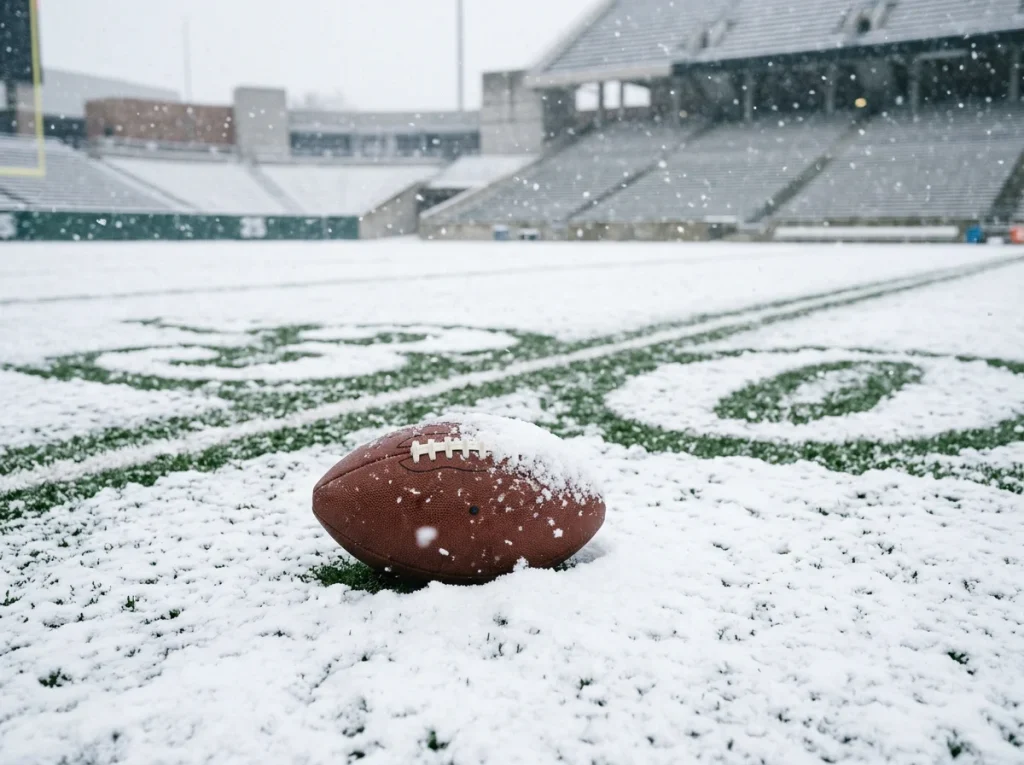
December 2022, Bills versus Dolphins in Orchard Park. The temperature at kick-off was minus six Celsius, wind chill pushing it to minus twenty-five. I’d checked the forecast three days earlier, watched the total sit at 46.5, and waited. By Saturday morning, when the severity of the conditions became clearer, the total dropped to 42. I backed the under at 42 — and the game finished 32-29. That loss taught me the most important lesson in weather betting: the market sees the forecast too, and by the time extreme weather is confirmed, the adjustment is often already priced in. The edge isn’t in knowing the weather; it’s in knowing how the weather interacts with specific teams, schemes, and player skill sets better than the market does.
For UK punters, weather as a betting variable feels foreign. Our football is played rain or shine with relatively little tactical impact from conditions. NFL is different — seventeen weeks of outdoor regular-season games across climate zones ranging from the subtropical warmth of Miami to the frozen tundra of Green Bay, with eight games a year in domed stadiums where weather is irrelevant. That variance creates opportunities the market sometimes misprices.
Wind Velocity Factors: Disrupting Passing Markets
I’ve tracked wind speed against scoring outcomes for five consecutive seasons, and the data is unambiguous: wind is the single most significant weather factor in NFL betting. Not rain, not snow, not temperature — wind. It suppresses scoring more reliably than any other condition because it directly impairs the two highest-efficiency scoring methods: the forward pass and the field goal.
Sustained wind above 15 mph has a measurable effect on passing accuracy and distance. Quarterbacks struggle to throw deep into the wind, and even intermediate routes become less predictable when the ball moves laterally in flight. The impact compounds at higher speeds — above 20 mph, deep passing becomes genuinely unreliable, and above 25 mph, even short passes can be affected by gusts. Field goals become a coin flip in sustained winds above 20 mph, with kickers regularly missing attempts they’d make on a calm day.
The betting implication is straightforward: high wind favours the under on game totals. But the nuance matters. A game between two run-heavy teams in 20 mph wind will see less scoring suppression than a game between two pass-heavy teams in the same conditions, because the run game is unaffected by wind. If the total hasn’t adjusted enough for the mismatch between team style and conditions, there’s value.
Wind direction relative to the field orientation matters and is frequently overlooked. A crosswind affects both teams equally on every possession. A headwind/tailwind alternates by quarter — one team faces the wind for two quarters, then has it at their back for two. This asymmetry can create scoring patterns within the game: more points in the quarters where the better passing team has the wind at their back, fewer in the quarters they face it. Quarter and half totals become interesting in these scenarios.
Rain, Snow and Playing Surface
My favourite snow game bet was a 2021 late-season match where both teams had strong rushing attacks and the forecast called for persistent heavy snowfall. The total was set at 39 — already low — but I backed the under, reasoning that field conditions would make even the run game harder to execute efficiently. The game delivered: sloppy footing, turnovers, stalled drives, and a combined score of 23. Snow games have a romanticism that can distort betting judgement, but the reality is usually ugly for offences.
Rain reduces scoring primarily through its effect on ball handling. Fumbles increase in wet conditions, particularly on handoffs and during contested catches. Passing games suffer because receivers struggle to create separation on slippery surfaces, and quarterbacks find grip more difficult. The effect is most pronounced in the first quarter, when the field surface is freshest and hasn’t yet been churned into mud — though modern NFL fields drain better than they used to, reducing the impact compared to previous decades.
Snow has a more dramatic visual impact but a similar mechanical one. Heavy snowfall obscures field markings, making it harder for receivers to run precise routes and for quarterbacks to identify defensive alignments. Footing deteriorates rapidly, neutralising speed advantages — which means teams that rely on fast, agile skill players are disproportionately affected compared to teams that play a physical, power-based style.
Playing surface type interacts with weather. Natural grass becomes significantly slower and more treacherous in rain than artificial turf. Games played on natural grass in heavy rain see a larger scoring reduction than the same conditions on modern artificial surfaces, which drain more effectively and maintain traction better. Checking the stadium’s surface type alongside the weather forecast adds precision to your assessment.
Temperature and Dome-to-Outdoor Transitions
A pattern I’ve noticed over years of tracking: the market overreacts to cold weather in isolation but underreacts to cold weather combined with wind. A game at minus five Celsius with calm winds in Green Bay won’t see dramatic scoring suppression — modern NFL players are conditioned for cold, and the ball behaves reasonably in cold dry air. But add 20 mph wind to that same temperature, and the combined effect on passing is severe. The interaction between variables is what the market sometimes gets wrong.
Cold weather affects grip strength, ball inflation (slightly), and player flexibility, but the impact on scoring is smaller than most recreational bettors assume. Studies of NFL games played below freezing show a modest reduction in scoring compared to games played in mild conditions — roughly two to three points on the combined total. This is already reflected in the market for well-known cold-weather venues. The edge, if any, comes from identifying specific cold-weather situations where the total hasn’t adjusted enough.
The more exploitable angle is the dome-to-outdoor transition. When a team that plays home games in a domed stadium — Atlanta, Las Vegas, New Orleans, Minneapolis — travels to an outdoor venue in December or January, they face conditions they haven’t practised in. The converse is also true: cold-weather teams travelling to domes can find the indoor speed of the game unsettling. These transitions are particularly relevant for playoff games, where a dome team might face a road game in Buffalo or Green Bay in conditions they’ve barely experienced all season.
The Sigma survey finding that 68% of British gamblers expect to increase their betting in 2026 suggests more UK punters will be engaging with late-season NFL games — precisely when weather becomes a decisive factor. Understanding how conditions interact with team composition is an analytical advantage that compounds as the season progresses and the stakes rise.
Practical Weather Betting for UK Punters
My weekly NFL routine includes a weather check every Friday morning. I pull up the hourly forecasts for all outdoor venues with Sunday games, note wind speed, precipitation probability, and temperature, then cross-reference against my existing totals and spread positions. It takes fifteen minutes and has prevented me from backing overs in games that turned into weather-affected slogs more times than I can count.
Timing your weather research matters. Forecasts become significantly more accurate within 48 hours of kick-off. Checking the weather on Wednesday for a Sunday game gives you a general picture, but the specifics — wind speed, gust predictions, rain timing — solidify by Friday or Saturday. Lines move on weather information too, so the earliest you can act on reliable data, the better the price you’ll get.
Several free resources provide game-specific weather data for NFL. NFLWeather.com and similar sites aggregate forecasts for every outdoor stadium, often including wind direction relative to the field. The National Weather Service provides hourly forecasts for specific coordinates, which is more granular than city-level forecasts — useful when a stadium is located near a body of water (like Chicago’s Soldier Field near Lake Michigan) where localised conditions can differ from the wider area.
Build a simple framework: for games with sustained wind above 15 mph, reduce your expected total by three to five points compared to calm conditions. For heavy rain or snow, reduce by two to three points. For cold-to-dome or dome-to-cold transitions, add one to two points of uncertainty to the spread. These aren’t rigid rules — they’re starting adjustments that you refine based on the specific teams, schemes, and player profiles involved. The over/under betting guide provides the broader framework for totals analysis into which weather adjustments slot naturally.
When Weather Edges Disappear
The most important thing I’ve learnt about NFL weather betting is knowing when there’s no edge at all. The market is efficient at pricing extreme weather once it’s widely known. If a blizzard is forecast for a Sunday game and every sports broadcaster in America is talking about it by Wednesday, the total will have adjusted by Thursday. Betting the under on a widely publicised snow game at the adjusted line is usually a breakeven proposition at best.
The edges exist in the margins: moderate wind that doesn’t make headlines but still affects passing, unexpected rain that arrives during the game after a dry forecast, or nuanced team-specific factors that the broad weather adjustment doesn’t capture. A team with an elite running back and a below-average passing game is less affected by wind than the market’s blanket total reduction suggests. A team with a dome-trained roster that’s been practising outdoors all week for a cold-weather road game may not be as disadvantaged as the spread implies.
Eight of the NFL’s thirty-two teams play home games in domed or retractable-roof stadiums. For those games, weather is irrelevant and shouldn’t factor into your analysis at all — unless one of the teams is visiting from an outdoor, cold-weather environment and might underperform in the climate-controlled speed of a dome. The remaining outdoor venues are where weather analysis matters, and even among those, some (Miami, Los Angeles, Tampa Bay) rarely experience conditions extreme enough to affect play significantly.
Selectivity, as with every betting angle, is what makes weather analysis profitable. You’re looking for three or four games per season where weather creates a genuine mispricing that the market hasn’t fully absorbed. The rest of the time, the weather is already in the line, and your energy is better spent on other factors.
Articles
Prepared by the GRIDLOCK editorial staff.
